Agog is committing up to $1 million in grants to support innovators, technologists, artists, organizers, researchers, organizations, studios, and creative teams using immersive media to engage people on climate, from awareness to action.
**The application window is now closed. Applications opened May 12 and closed June 12, 2026 at 11:59 pm. PT. Please sign up for our email list or follow us on social media to stay up to date with future opportunities.**
About the Open Call
This open call supports immersive media projects that help people better understand and respond to climate challenges and imagine what a better world could be.
We are looking for projects that use immersive technologies—including smart glasses, augmented reality, spatial sound, and mixed reality—to create more engaging, experiential forms of climate storytelling and civic participation.
The open call will support projects across a range of stages and formats, from early ideas to more developed work. What matters most is a compelling story or experience, a clear sense of purpose, and a thoughtful approach to bringing the work to life.
The review committee includes Agog leadership and climate and XR experts, including Myriam Achard, chief of new media partnerships and PR at PHI; Jerome Foster II, environmentalist; Anthony Leiserowitz, Ph.D., director of the Yale Program on Climate Change Communication; and Jacqueline Patterson, founder and executive director of The Chisholm Legacy Project. Grants may be awarded in denominations ranging from $25,000 to $200,000. In addition to funding, selected projects may receive mentorship, advisor support, and opportunities for partnership and distribution.
What We’re Looking For
Here are some ways we envision these tools could be used:
- Climate storytelling and civic participation: Place-based, immersive experiences that help people viscerally understand climate change and inspire meaningful civic engagement, organizing, and collective action.
- Community power and resilience: Resources that put real-time information, coordination capacity, and decision-making power in the hands of frontline communities before, during, and after climate disasters.
- Access and equity: Projects that center communities most impacted by climate disasters and explore pathways for repair, sovereignty, landback, and community-led climate leadership.
- Planetary connection: In the face of climate anxiety, tools and experiences that support and deepen meaningful connection to the natural world through immersive media.
- Future-building and world design: Projects that help us expand our collective imagination to envision a more livable, connected, and thriving future.
- Your brilliant ideas: Bold, imaginative approaches that we haven’t yet thought of that expand what climate participation can feel and look like for the public good.
Projects that align with the spirit of using immersive media to rally people around climate realities and creating the future we want were encouraged to apply.
All Experience Levels Welcome
Both XR creators and mission-driven organizations were encouraged to apply. We welcomed projects from organizations with strong climate-focused work that are newer to XR and interested in exploring how immersive media can expand their impact.
Key Dates
- May 12, 2026—Applications opened
- June 12, 2026—Applications closed at 11:59 p.m. PT. No late applications accepted.
- By fall 2026—All applicants notified of final decisions
Information Sessions
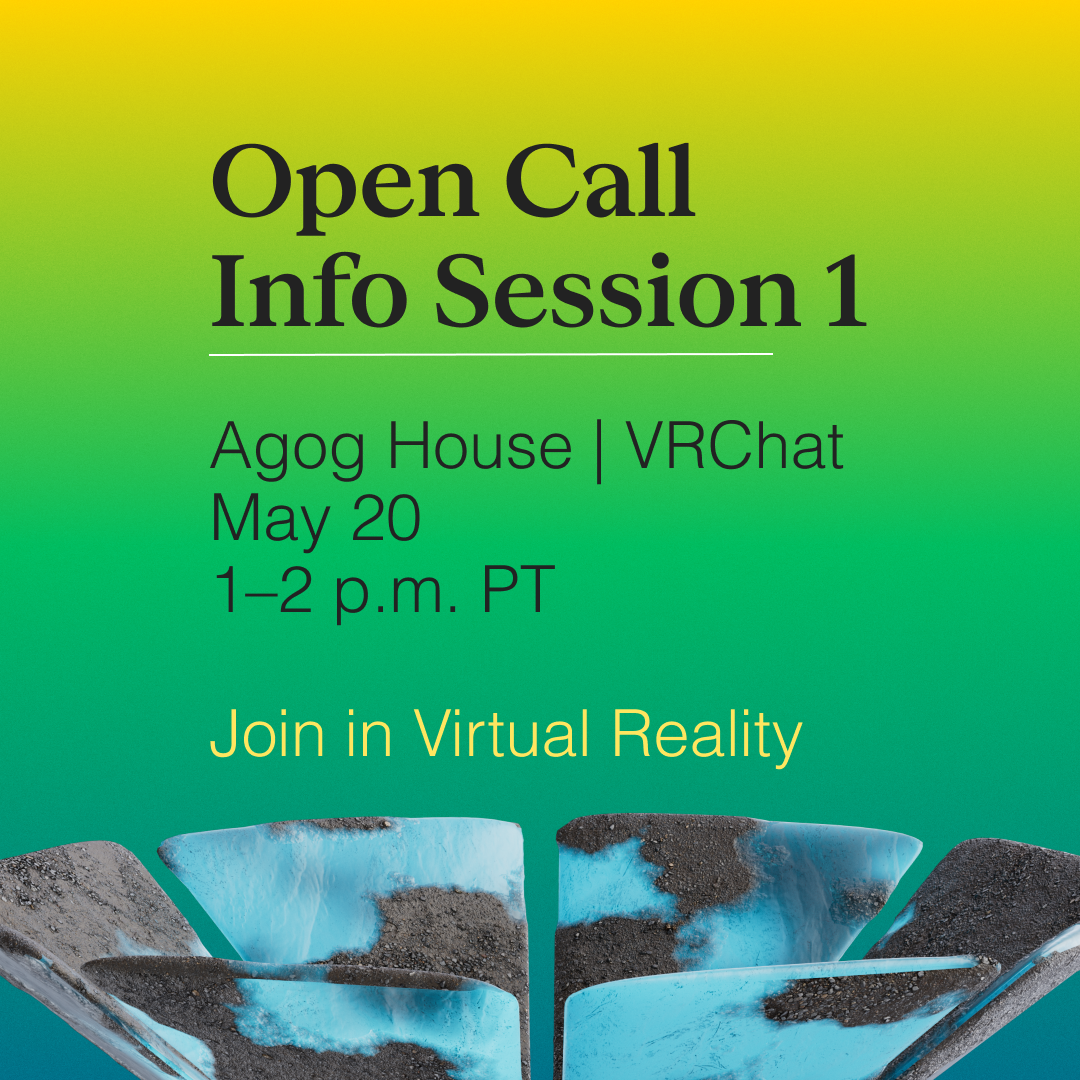
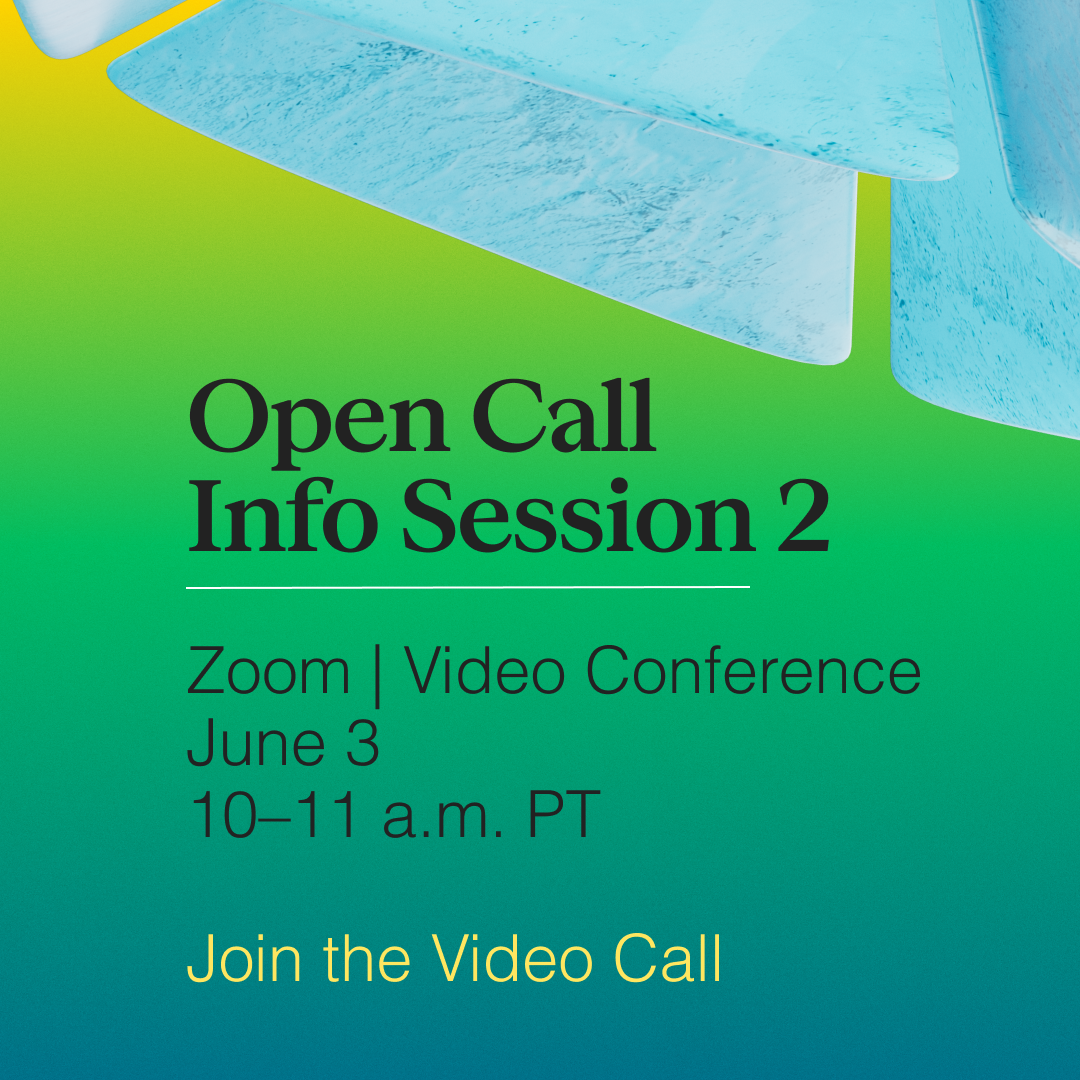
Questions?
If you have questions about eligibility or the application process, please explore the FAQs or watch a recording of one of the information sessions. We also encourage you to join us on Discord where we will be sharing updates and answering common questions.
Overview
Agog: The Immersive Media Institute is a philanthropic organization founded by Chip Giller and Wendy Schmidt that is dedicated to helping creators and nonprofit leaders use extended reality (XR)—including virtual, augmented, and mixed reality—to imagine and build a more connected, just, and compassionate world. Agog operates as a field builder supporting immersive storytellers whose work addresses urgent social and environmental challenges.
The Agog Open Call: Climate Futures + Immersive Media is a funding initiative providing up to $1 million in grants to support creators, technologists, artists, studios, organizations, and creative teams using immersive media to engage people in climate issues and inspire action. This is Agog’s first open call, designed to expand access to funding and support for immersive storytelling projects that help people better understand, imagine, and respond to climate challenges.
This open call focuses on projects that use immersive media to move people from awareness to action on climate issues. We are looking for proposals that explore how tools like augmented reality, spatial audio, virtual reality, mixed reality, and other immersive formats can deepen understanding, strengthen community connection, and support meaningful participation in climate solutions. We aim to support charitable work that strengthens community resilience, advances climate justice, deepens connection to the natural world, or helps people imagine and build more livable futures.
Eligibility and Fit
Both extended reality (XR) creators and mission-driven organizations were encouraged to apply. We welcomed applications from organizations with strong climate-focused work that are newer to XR and interested in exploring how immersive media could expand their impact. All applications must be submitted through a registered entity (e.g., organization, company, or fiscal sponsor).
The open call is currently limited to US-based applicants. We recognize that climate challenges are global and encourage collaboration across geographies where appropriate.
Yes. Projects may include international collaborators, partners, or participants. However, the entity receiving funding must be based in the US.
No. Applicants must apply through an entity—e.g., a nonprofit, company, or fiscal sponsor. If you are an individual and do not currently have a fiscal sponsor, we encourage you to identify one.
Yes, you may submit more than one application if they are for distinct projects. Each application should represent a unique proposal.
Application
No. We welcome projects at all stages—everything from R&D through audience-development campaigns will be considered. However, applicants should demonstrate a clear vision for the immersive media experience, a thoughtful approach to using immersive technology, and a realistic path to execution.
Project Scope and Alignment
We are interested in projects that use immersive media to engage people in climate issues and expand pathways for participation and action.
We are particularly interested in projects that explore one or more of the following areas:
- Climate storytelling and civic participation—Experiences that help people understand climate issues and inspire collective action or engagement
- Community power and resilience—Tools or stories that support frontline communities in preparing for, responding to, or shaping climate solutions
- Access, equity, and climate justice—Work that centers communities most impacted by environmental harm and advances community-led leadership and solutions
- Planetary connection and well-being—Experiences that deepen connection to the natural world and support emotional resilience in the face of climate change
- Future-building and world design—Projects that help people imagine and engage with more livable, sustainable, and connected futures
These themes are intended to suggest the types of projects we are excited to support, but they are not strict categories. If your project uses immersive media in other ways to engage people in climate issues and inspire action, we encourage you to apply!
While projects may vary widely in approach, the strongest submissions tend to demonstrate the following:
A clear and compelling climate story or experience
The project has a well-defined idea that helps people viscerally understand climate change. It’s clear why this story matters now and what it contributes to broader conversations about climate futures.
A strong use of immersive technology
The proposal shows why immersive media is the right medium to use to support the story, experience, or intended impact.
Clarity on audience and intended impact
Strong applications clearly identify whom the work is for, why it matters to them, and how it can foster greater understanding of and action on climate issues. They demonstrate an understanding of how the project will engage audiences, spark reflection, or otherwise contribute to meaningful outcomes.
A realistic path to execution or development
Whether the project is early-stage or more developed, strong proposals show a credible path forward, including a clear production plan and description of organizational capacity to carry the work through.
Meaningful connection to communities represented
Projects demonstrate care and intention in how they engage with the people and communities at the center of the work.
Specificity and clarity
Strong applications are concrete and easy to understand, clearly describing what the project is, how it works, and what it aims to do.
Immersive Media
By immersive media, we mean technologies that create a sense of presence, allowing people to experience, explore, or interact with digital content in embodied or spatial ways.
Examples include augmented reality (AR), virtual reality (VR), mixed reality (MR), spatial audio, and shared or social XR environments.
We are interested in projects that use these tools to create engaging, experiential forms of storytelling and participation.
We welcome a wide range of immersive formats and approaches. We are particularly interested in, but are not limited to, projects that revolve around:
- Smart glasses and mixed-reality wearables: Wearable devices that overlay digital content onto the physical world. Glasses, for example, could enable site-specific storytelling, guided experiences, data visualization, and interactive public engagement layered onto real environments.
- Spatial sound: Spatial sound places voices, environments, and effects around the listener, enhancing emotional depth, memory, and presence. Audio that exists in 3D space allows listeners to experience sound as directional, immersive, and embodied.
- Social XR: Shared immersive environments that foster a sense of community and connection. Experiences can bring users together in shared/multiplayer environments either in real time or asynchronously using VR, AR, MR, etc.
- Multiplayer mixed-reality experiences: Interactive installations that merge digital and physical elements into a unified spatial experience. We’re particularly interested in experiences that audiences can move through collectively.
Immersive technology is evolving quickly, and we recognize that not all approaches fit neatly into existing categories. If your project uses emerging or unconventional tools and aligns with the spirit of immersive media, we encourage you to apply.
No. Projects do not need to be fully developed or already built to apply. We are interested in the strength of the idea, its potential to translate into an immersive experience, and the clarity of the creative, technical, and impact approach.
Yes. Projects may incorporate AI or generative tools as part of the creative or technical approach. We encourage you to describe clearly how AI is being used and how it contributes to the overall experience.
Funding and Support
If your project is selected, a fiscal sponsor (or other eligible entity) will be required to receive grant funding.
Agog has committed up to $1 million in total grants for this open call. Individual grant amounts will vary depending on the scope, stage, and needs of each project.
Funding may be used to support various aspects of project development and impact, including creative development, production, technical development, collaboration, and distribution.
Funding may support either full projects or specific phases/elements of a project. Given the scope of immersive production, many of the grants will function as catalytic support, helping advance a project through a key stage such as prototyping, development, or expansion rather than fully funding large-scale productions.
Applicants need to provide an estimated funding request and overall project budget. Finalists may be required to submit more budget details.
We expect to fund a range of projects across different grant sizes. Final numbers will depend on the strength and scope of applications.
Applicants may include overhead and indirect costs in their projected budgets. We do not have written guidance regarding indirect cost rates or caps for this open call.
Application Process
Applicants will be asked to provide basic information about their organization and proposed project, including a project description, intended user experience, audience and impact goals, team or organizational capacity, budget, and relevant supporting materials (optional), such as decks, prototypes, or work samples.
The application platform allows you to start, save, and return at any time before submitting.
No. Once an application is submitted, it cannot be edited.
After submission, applications are reviewed by Agog staff and a review committee including external experts. A subset of proposals will move forward to additional rounds of review, including possible interviews. All applicants will be notified once final decisions have been made.
Our review committee includes:
- Myriam Achard, Chief of New Media Partnerships & PR, PHI
- Jerome Foster II, environmentalist
- Anthony Leiserowitz, PhD, Director, Yale Program on Climate Change Communication
- Jacqueline Patterson, Founder and Executive Director, The Chisholm Legacy Project
Due to the expected volume of applications, we are not able to provide specific or individual feedback.
Timeline
Applications opened on May 12 and closed on June 12 at 11:59 p.m. PT. Late applications will not be accepted under any circumstances.
We anticipate decisions will be made in the fall of 2026.
Additional Questions
Join us on Discord where we will be sharing updates and answering common questions, or reach out to our Programs team at grants(at)agog.org.